A home with a 3-ton central AC, fridge, freezer, furnace, lights, and TV lands on 14 kW. With a soft starter on the AC, the same list fits a 10 kW unit.
The method in three steps
- Running watts: add up the watts of everything that will run at the same time.
- Starting surge: add the extra watts of the single biggest motor start. In homes with central air, that is almost always the AC compressor.
- Margin: multiply by 1.25 and round up to the next standard standby size (10, 14, 18, 20, 22, 24, 26 or 32 kW).
The wattage of each appliance is listed and cited on our generator size calculator.
Worked example: a home with a 3-ton central AC
Loads: refrigerator, freezer, 3-ton central AC, gas furnace blower, LED lights and TV.
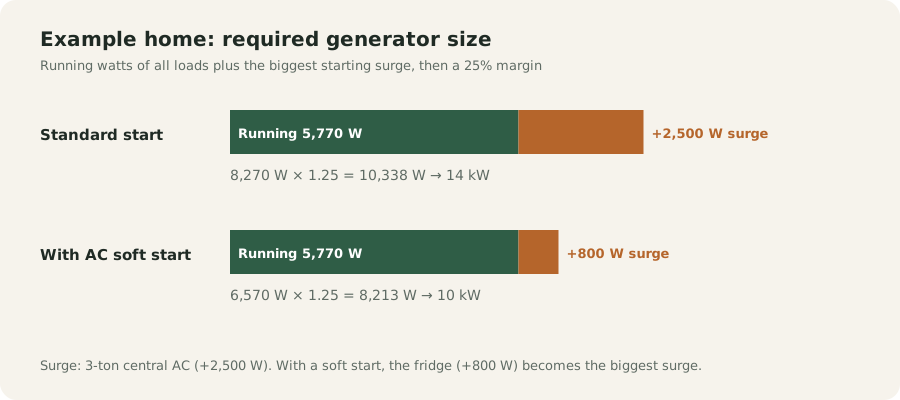
- Running watts: 5,770 W
- Biggest starting surge: the AC compressor, +2,500 W
- Required: 5,770 + 2,500 = 8,270 W
- With margin: 8,270 x 1.25 = 10,338 W, so the next standard size is 14 kW
How a soft starter changes the answer
A soft starter ramps the AC compressor up gently instead of all at once. One manufacturer rates its unit at a 65 to 75% reduction in starting current, and markets it for running AC on generators. (ACHR News (opens in a new tab))
If the AC's surge drops below the refrigerator's, the fridge becomes the biggest surge:
- 5,770 + 800 = 6,570 W
- x 1.25 = 8,213 W, so 10 kW
That is an estimate: the actual effect depends on your AC and the starter model, so ask your HVAC technician and electrician to confirm.
What pushes the size up
- Electric heat, a heat pump, an electric range or an electric dryer.
- A well pump, which is another big motor start.
- Running two large motors that might start at the same time.
Safety first
Have a licensed electrician install a transfer switch, and a gas fitter run the fuel line. A local permit is typical. Do not tie a generator into house wiring without that switch.
Try your own appliance list in the generator size calculator, then send the result to the generator cost calculator to see installed price ranges for that size.