For a 12 x 16 ft shed, a 14 x 18 ft pad at 4 inches is about 3.11 cubic yards, or roughly 4.4 tons of crushed stone.
Step 1: Size the pad 12 inches wider than the shed
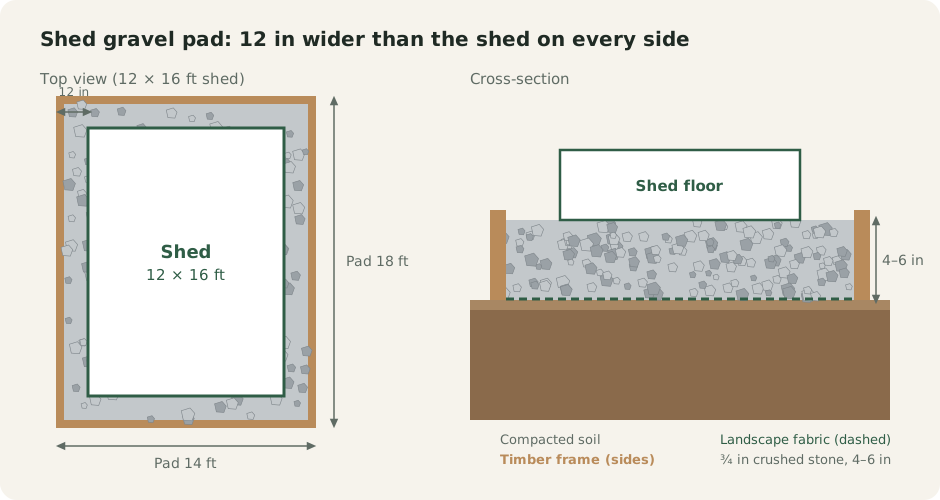
The pad should extend about 12 inches past the shed on every side, so it is 2 feet longer and 2 feet wider than the shed itself. That border keeps rain from splashing mud onto the siding, keeps grass and weeds away from the walls, and gives roof water somewhere to soak in. (SitePrep (opens in a new tab))
Step 2: Choose the depth
Plan on 4 to 6 inches of stone. Use 6 inches on soft clay or wet ground, or for a heavy shed. (SitePrep (opens in a new tab), This Old House (opens in a new tab))
Step 3: Do the math
Multiply pad length by width by depth in feet, then divide by 27 for cubic yards.
For a 12 x 16 shed with a 14 x 18 pad at 4 inches:
- 14 x 18 = 252 square feet
- 4 inches = 0.333 feet, so 252 x 0.333 = 84 cubic feet
- 84 / 27 = 3.11 cubic yards
- At 1.40 tons per cubic yard (our default for crushed gravel): about 4.4 tons
If you add 10% extra, this job is about 3.4 cubic yards or 4.8 tons. Ask your supplier how their stone compacts.
Gravel for common shed sizes
Pads are 12 inches wider than the shed on every side. Tons use 1.40 tons per cubic yard and do not include extra for compaction.
| Shed | Pad | 4 in deep | 6 in deep |
|---|---|---|---|
| 8 x 10 ft | 10 x 12 ft | 1.48 yd³ (2.1 t) | 2.22 yd³ (3.1 t) |
| 10 x 12 ft | 12 x 14 ft | 2.07 yd³ (2.9 t) | 3.11 yd³ (4.4 t) |
| 12 x 16 ft | 14 x 18 ft | 3.11 yd³ (4.4 t) | 4.67 yd³ (6.5 t) |
| 12 x 20 ft | 14 x 22 ft | 3.80 yd³ (5.3 t) | 5.70 yd³ (8.0 t) |
Which stone to use
Use angular crushed stone, such as 3/4 inch clean crushed stone. The sharp edges lock together when compacted and make a firm, level surface. Rounded pea gravel does not pack down and moves underfoot, so it is a poor choice under a shed. (KidsGardening (opens in a new tab))
How the pad goes together
- Mark the pad and dig out 4 to 6 inches of soil.
- Compact the soil with a plate compactor or hand tamper. Dampen it and compact again until it is firm.
- Lay heavy-duty landscape fabric to block weeds and keep the stone from sinking into the soil.
- Build a frame from ground-contact pressure-treated timbers to hold the stone in place.
- Spread the stone, level it with a straight board, then tamp and dampen it. Fill low spots and tamp again.
(This Old House (opens in a new tab))
Before you dig, check local setback rules and whether your town needs a permit for the shed.