Plan on 6 to 8 inches of compacted crushed stone under a patio, plus about 1 inch of bedding sand. A 12 x 12 ft patio with a 6-inch base needs about 2.9 cubic yards of gravel (4 tons) and 0.44 cubic yards of sand.
The layers, from the top down
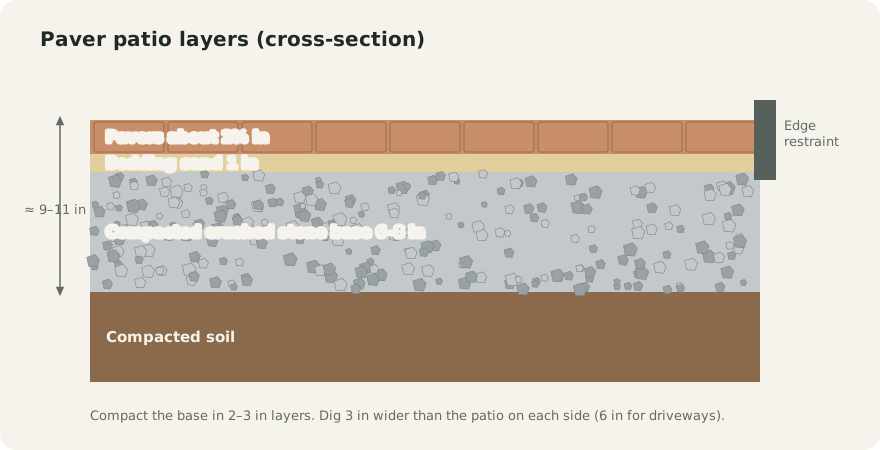
- Pavers: often about 2 3/8 inches thick for patios.
- Bedding sand: about 3/4 to 1 inch of coarse concrete sand, screeded flat. (Unilock (opens in a new tab))
- Base: a minimum of 6 to 8 inches of compacted gravel for patios and walkways, and 10 to 14 inches for driveways. (Unilock (opens in a new tab))
- Soil: compacted before any stone goes in.
Unilock's newer contractor guidance recommends a deeper base, about 10 to 12 inches for patios and walkways and 14 to 16 inches for driveways. (Unilock (opens in a new tab)) The 6 to 8 inch figure is the minimum; go deeper on clay, wet ground or anywhere with hard freezes.
Use angular crushed stone for the base
The base should be angular crushed stone. The sharp edges interlock and compact into a firm layer. (Unilock (opens in a new tab)) Rounded stone like pea gravel does not pack down and keeps moving, so it is wrong for a base. (KidsGardening (opens in a new tab))
Worked example: a 12 x 12 ft patio
Excavate wider than the patio. Dig at least 3 inches wider on each side so the base supports the edge restraint. (Unilock (opens in a new tab)) For a 12 x 12 patio, the base area is 12.5 x 12.5 ft.
Gravel base, 6 inches:
- 12.5 x 12.5 = 156.25 square feet
- x 0.5 ft = 78.1 cubic feet
- / 27 = 2.89 cubic yards, about 4.05 tons at 1.40 tons per cubic yard
At 8 inches the same base is 3.86 cubic yards, about 5.4 tons.
Bedding sand, 1 inch:
- 12 x 12 = 144 square feet x 0.083 ft = 12 cubic feet
- / 27 = 0.44 cubic yards, about 0.62 tons at 1.40 tons per cubic yard
Total dig depth: 6 inches of base + 1 inch of sand + about 2 3/8 inches of paver = about 9.4 inches below the finished surface.
Compact in layers
Spread and compact the base in 2 to 3 inch layers with a plate compactor, not all at once. A 6-inch base is two or three passes of spreading and compacting. (Unilock (opens in a new tab))
Use the gravel calculator for the base and the sand calculator for the bedding layer; both take your patio size and depth.