Use crushed stone for paths, driveways, shed pads, and paver bases. Use pea gravel for beds, play areas, and drainage, where a loose surface is fine.
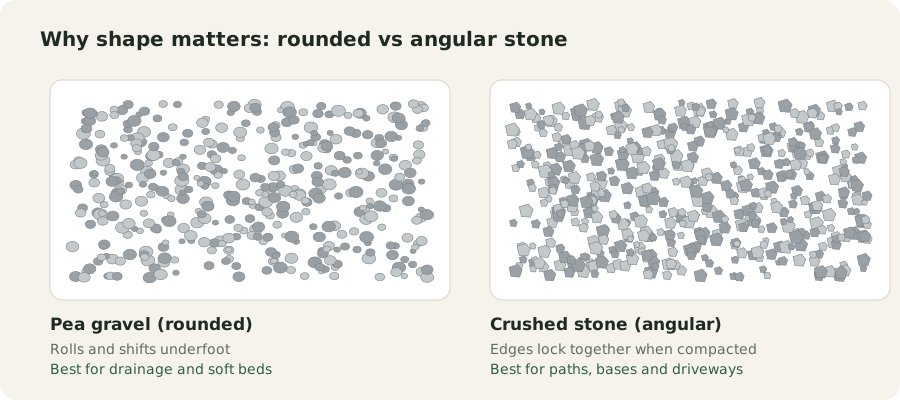
Pea gravel: round, loose, free-draining
Pea gravel is small and rounded. Because the pieces cannot lock together, it does not pack down and stays loose. One garden education group compares walking on it to walking on marbles. (KidsGardening (opens in a new tab))
Good for: decorative beds, play areas, around downspouts, drainage trenches and dog runs.
Crushed stone: angular, packs firm
Crushed stone is broken by machines into sharp, angular pieces. When you compact it, the edges lock together and pack down into an almost solid surface. (KidsGardening (opens in a new tab)) That is why paver manufacturers specify angular crushed stone for bases. (Unilock (opens in a new tab))
Good for: walkways, driveways, shed pads, paver and patio bases.
Side by side
| Pea gravel | Crushed stone | |
|---|---|---|
| Shape | Round and smooth | Angular, sharp edges |
| Compacts firm? | No, stays loose | Yes, locks together |
| Feel underfoot | Shifts and rolls | Firm once compacted |
| Drainage | Very free-draining | Good, less with fine dust |
| Typical weight (our calculators) | about 1.25 tons per cubic yard | about 1.35 to 1.40 tons per cubic yard |
| Best uses | Beds, play areas, drainage | Paths, driveways, bases |
Can I use both?
Yes, and it is common. Lay a compacted crushed stone base first, then a thin top layer of pea gravel for looks. Keep the pea gravel layer thin (about an inch or two) and use a solid edging, so it does not roll into the lawn. A thick layer of pea gravel on top brings the loose, shifting feel back.
Working out how much you need
For a 20 ft x 3 ft path at 3 inches:
- 20 x 3 x 0.25 ft = 15 cubic feet = 0.56 cubic yards
- Pea gravel at 1.25 tons per cubic yard: about 0.7 tons
- Crushed stone at 1.40 tons per cubic yard: about 0.78 tons
Use the pea gravel calculator or the gravel calculator with your own sizes; both give cubic yards, tons and bags.