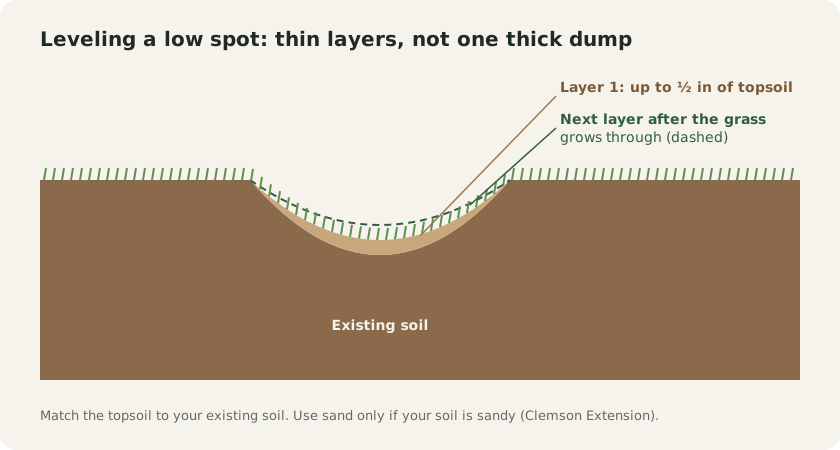
Spread no more than half an inch of topsoil at a time over the grass. Half an inch over 500 square feet is about 21 cubic feet, or 0.77 cubic yards.
The rule: half an inch at a time
Spread no more than half an inch of material in one go. Thicker layers can stunt the grass or shade it out. (Clemson Extension (opens in a new tab), Sod Solutions (opens in a new tab))
How much topsoil you need
Measure the uneven area, not the whole lawn. Then: square feet x depth in feet / 27 = cubic yards.
| Area to level | Half-inch layer | Cubic yards | Bags (0.75 cu ft) |
|---|---|---|---|
| 100 sq ft | 4.2 cu ft | 0.15 | 6 |
| 500 sq ft | 20.8 cu ft | 0.77 | 28 |
| 1,000 sq ft | 41.7 cu ft | 1.54 | 56 |
For a dip that is 1.5 inches deep, plan on three passes, so three times the amount for that spot, spread over the season.
Pick the right material
- Topsoil that matches your soil. True topsoil contains organic matter; it should be similar to what is already in your yard.
- Sand only if your soil is sandy. Sand on clay soil creates layers that drain poorly.
- Compost works on every soil type and improves soil structure.
- Topsoil and river sand can carry weed seeds, so buy from a supplier you trust. A soil test of both your soil and the material takes about two weeks and shows the pH and nutrients.
(Clemson Extension (opens in a new tab))
How to apply it
- Mow a little shorter than usual, without scalping the grass.
- If the soil is compacted, core aerate first.
- Shovel small piles onto the low spots, then rake and brush the soil in so the grass blades still poke through.
- Water the same day so the soil settles and you can see the true level.
- Wait until the grass has grown through, then repeat on spots that are still low.
Do this during the grass's active growing season. (Clemson Extension (opens in a new tab), Sod Solutions (opens in a new tab))
Use the topsoil calculator with your area and a depth of 0.5 inches for each pass.